
Posted by Peter Glenn Staff on Nov 14th 2025
Table of Contents
At a Glance: Quick Steps to Improve Skiing Balance
- Start with a proper skiing stance: centered with knees slightly bent and weight balanced over the outside ski.
- Train your core, legs, and hips with exercises like planks, squats, and lunges to build muscle strength and stability.
- Practice off-snow balance drills like single-leg holds and balance boards to develop reaction control.
- On-snow, focus on drills like weight shifts, lifting the inside ski, and keeping your hands forward to reinforce balance during turns.
- Regularly integrate balance and strength exercises into your weekly routine for steady improvement.
Why Balance and Stance Matter in Skiing
Balance in skiing is your ability to stay centered over your skis and move smoothly while adapting to different snow conditions and pitches. Good balance allows you to carve turns, adjust your speed, and confidently navigate steeper terrain. It also helps prevent injury by ensuring even force distribution across your joints and muscles. Skiing requires constant adjustment to the terrain beneath you, and balance is the key to managing these shifts effectively. Without it, you may find yourself overcompensating or struggling to maintain control, especially on tricky or changing surfaces.
A centered stance is key to better balance. Your body should be aligned as follows:
- Ankles flexed so your shins lightly contact the front of your ski boots
- Knees slightly bent, not locked or pushed too far forward
- Hips aligned over the feet, chest facing downhill
- Hands holding ski poles slightly forward, not pulled back
This position helps keep your weight centered over your outside ski during turns. When your stance is properly aligned, your body naturally distributes the forces you encounter while skiing, including gravitational pull, terrain changes, and speed shifts, so you stay stable even in challenging conditions.
To check your stance, practice shifting your weight forward, back, and side to side on a gentle slope until you find where you feel steady.
One common mistake is leaning back, which makes skiing harder to control. Keep your lower leg engaged against the front of your boots to avoid this.
If you’re not centered, you may overuse your upper body or rely too heavily on your lower legs, which can cause unnecessary strain and reduce control.
Strength and Balance: How They Work Together
Balance is not only about coordination. It also comes from muscle strength and stability. Your entire body helps you stay steady, especially your legs, core, and hips. Strength training supports balance, and good balance allows you to use your strength more efficiently, resulting in improved skiing performance and injury prevention. This combination also plays a key role in injury prevention. When your muscles are strong and working together, they provide better control and less risk of strain, twists, or falls.
Focus Areas for Balance Exercises:
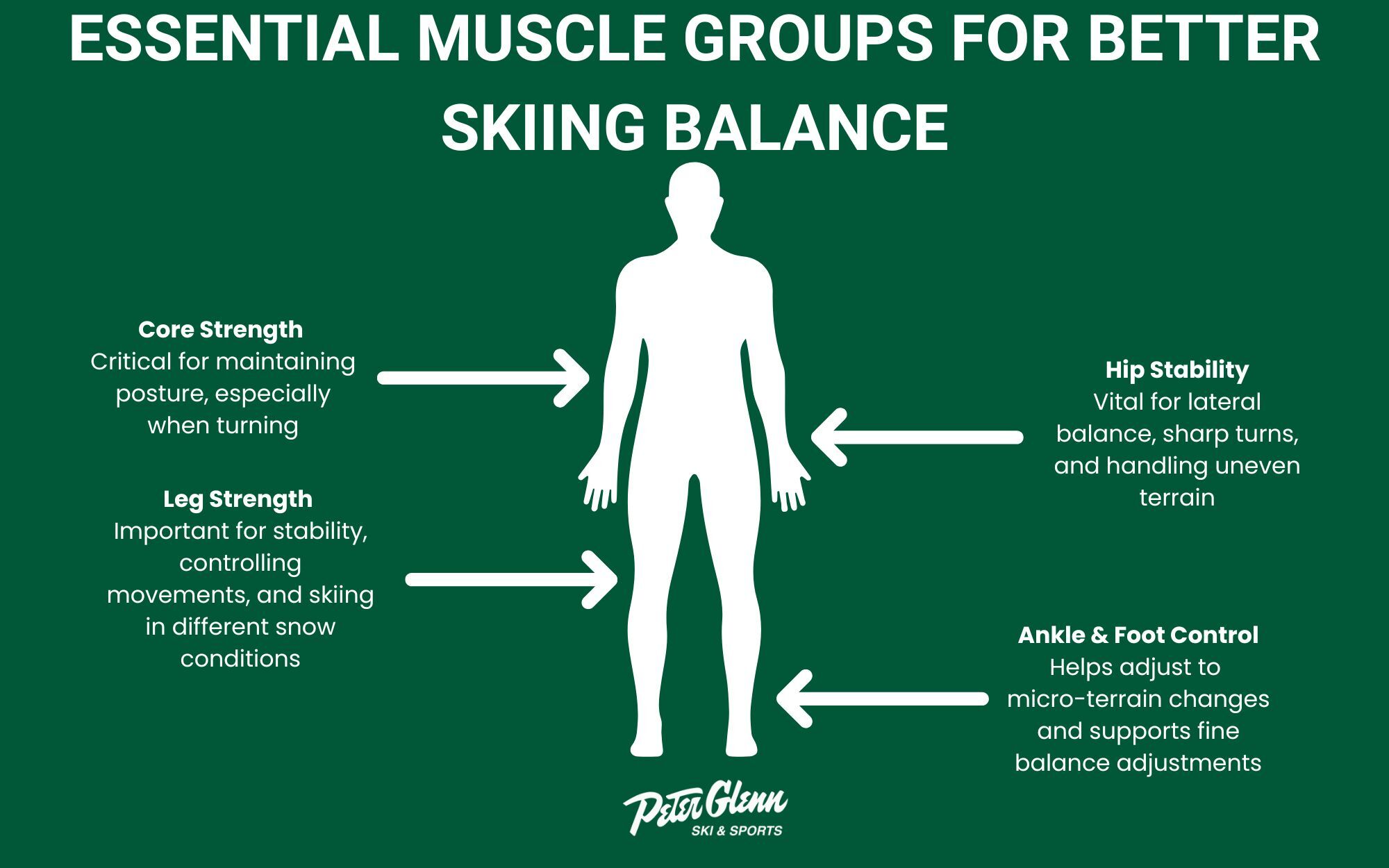
To improve balance in skiing, focus on strengthening key muscle groups that are essential for stability and movement control.
- Core Muscles: These help keep your upper body steady while skiing. Strengthening your core will help you maintain posture and alignment, particularly when turning or adjusting your speed. Effective exercises include planks, dead bugs, and bird dogs.
- Lower Body: Your legs are responsible for supporting and steering your weight as you ski. Strong lower body muscles will help you maneuver through different snow conditions and terrain. Squats, step-ups, and lunges are great exercises for building lower body strength.
- Hips and Glutes: These muscles control lateral balance and stability, which are crucial when making sharp turns or handling uneven terrain. Side lunges and band hip walks are excellent exercises to target this area.
- Ankles and Feet: The muscles in your ankles and feet help adjust to uneven snow and small shifts in terrain. Strengthening these muscles will improve your ability to make subtle balance adjustments. Calf raises, toe raises, and balance board exercises are great for improving ankle and foot strength.
When these muscle groups work together, they allow for smoother, more coordinated movements, improving overall skiing performance and balance.
Off-Snow Balance Training Exercises
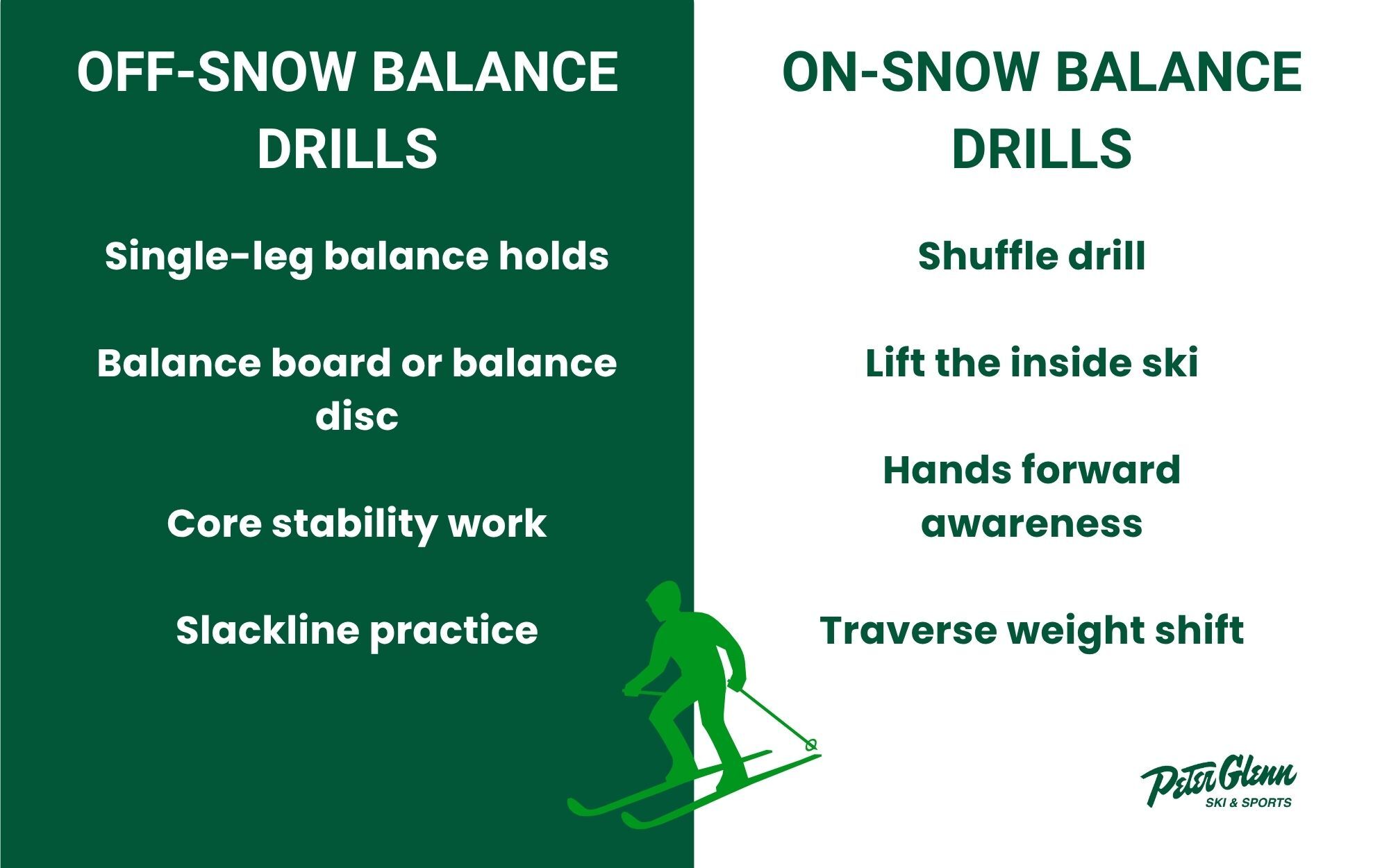
You can practice balance all year, even without snow. Off-snow exercises build baseline stability so skiing movements feel more natural.
1. Single-Leg Balance Holds
- Stand on one leg for 30 to 60 seconds
- Switch sides
- To increase the challenge, close your eyes or rotate your head slightly
This works ankle strength and control, which helps with micro-adjustments while skiing.
2. Balance Board or Balance Disc
These tools develop reaction control and motor coordination.
- Stand on the board for 1 to 2 minutes.
- Progress to squatting slowly, keeping your movements steady.
This trains your nervous system to respond quickly to balance changes.
3. Core Stability Work
- Plank: 30 to 60 seconds
- Side plank: 20 to 40 seconds each side
- Dead bugs: 8 to 12 repetitions per side, moving slowly
A strong core provides a stable foundation for both upper and lower body movements on snow.
4. Slackline Practice (Optional)
If you have a slack line:
- Set it close to the ground
- Focus on slow, controlled steps
This builds coordination and micro-stability in the feet, knees, and hips.
On-Snow Balance Drills
Once you are skiing, practicing balance directly on snow helps transfer your training to movement.
1. Shuffle Drill
- On gentle terrain, move your feet slightly forward and back as you ski
This encourages even pressure distribution across both skis.
2. Lift the Inside Ski
- During a turn, lift your inside ski for a short moment
This teaches you how to balance on your outside ski, which improves turn control.
3. Forward Pole Position
- Keep your ski poles held slightly forward while skiing
This helps maintain alignment between your hips and feet.
4. Hands Forward Awareness
- Traverse across the slope
- Shift weight gradually toward the downhill ski
This trains your balance response in sloped positions.
Improving Balance with Ski Lessons, Gear, and Consistent Practice
Ski instructors can help you make small adjustments to improve your balance, especially if you struggle with variable terrain or lean back too much. Lessons are great for replacing bad habits with better techniques. Instructors can pinpoint flaws in your form, accelerating progress and improving your overall skiing technique. If you struggle with mobility or past injuries, physical therapists can offer targeted exercises to enhance your range of motion and posture, aiding balance.
Your gear setup plays a big role in balance. Proper ski boots are essential for good control. If your boots are too loose or stiff, they can make balancing harder. Signs your boots may be affecting your balance include:
- Difficulty flexing forward naturally
- Heels lifting inside the boots
- Instability on easy terrain
Ski length and flex also matter. Shorter skis are easier to control at lower speeds, while longer skis provide more stability at higher speeds. Additionally, the mounting position of your bindings affects your balance point. If you feel unstable despite good technique, a ski technician can help evaluate your setup.
To build balance, practice consistently. You don’t need long sessions—just regular, focused work. An example training week could include:
- Day 1: Lower body strength + core (20-30 minutes)
- Day 2: Balance board + single-leg exercises (10-20 minutes)
- Day 3: Ski technique drills on snow or indoors (15 minutes)
With regular practice, you’ll see steady improvement in your balance and overall skiing performance.
Shop Peter Glenn
Improving skiing balance involves practicing strong posture on snow and training the muscle groups that support controlled movement. Good balance helps skiers turn with confidence, react to changing terrain, and feel steady on steeper slopes. With training that includes core exercises, lower body strength, and focused balance work, your skiing can feel smoother and more coordinated. Using on-snow drills to reinforce body awareness helps these improvements carry into real skiing situations.
If you want gear that supports balance and comfort, Peter Glenn carries skis, ski boots, pants, jackets, and accessories from trusted outdoor brands. Head to a store or shop online and discover the gear that will help you enjoy every run this season.