
Posted by Peter Glenn Staff on Jan 30th 2026
Table of Contents
The Short Answer: The best ski goggles offer clear vision across all light conditions, a comfortable fit that works with your ski helmet, and quality lens options for changing weather. Look for goggles with UV protection, anti-fog coating, and the right lens shape for your face.
Picking the right snow goggles makes a real difference on the mountain. Poor visibility from fog, glare, or the wrong lens tint can ruin an otherwise perfect day. The good news is that goggle technology has come a long way, and there are solid options at every price point.
Lens Shape: Spherical vs. Cylindrical
Lens shape affects both your field of view and how the goggles handle light. The two main options are spherical lenses and cylindrical lenses.
Spherical Lenses
A spherical lens curves both vertically and horizontally, mimicking the shape of your eye. This spherical shape provides better peripheral vision, reduces distortion at the edges, and creates more air volume inside the goggle to help prevent fogging. Models like the Oakley Flight Deck and Smith 4D Mag use spherical designs. The tradeoff is that spherical lenses sit farther from your face and tend to cost more.
Cylindrical Lenses
A cylindrical lens curves only horizontally, creating a flatter profile. These goggles sit closer to your face, often work better for smaller faces, and typically come at a lower price point. While they may have slightly less peripheral vision than spherical lenses, modern cylindrical lens designs still offer excellent optical quality for most riders. Many beginner and intermediate skiers find cylindrical lenses work perfectly well for their needs.
Choosing Lenses for Different Conditions
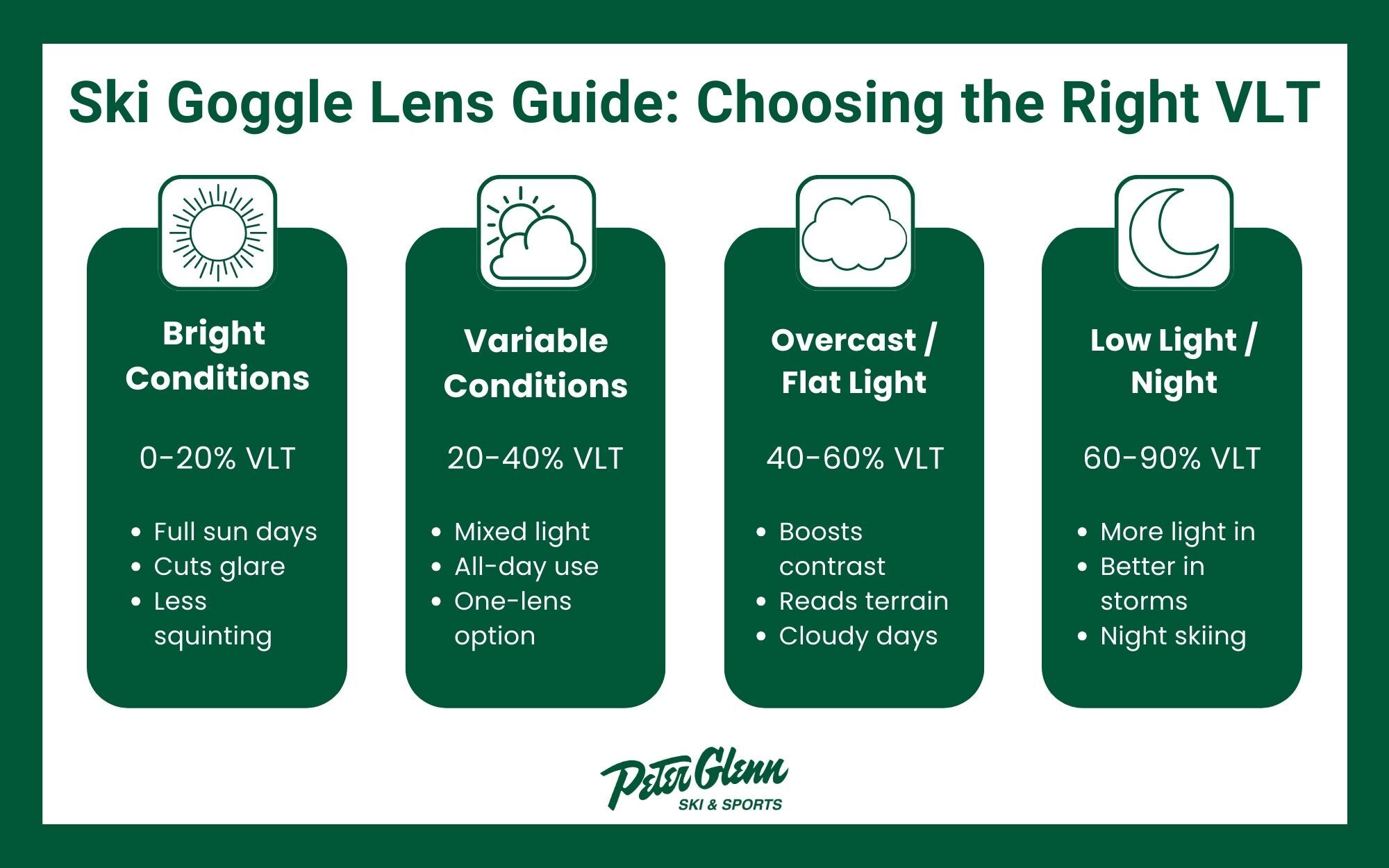
Visible light transmission (VLT) measures how much light passes through a goggle lens. Higher VLT percentages let more light through, which is better for low light and overcast conditions. Lower VLT blocks more light for bright sunlight and sunny days.
VLT Ranges by Condition
- Bright conditions (0-20% VLT): Dark lenses for bright light, sunny days, and high-altitude locations like Lake Tahoe, where UV radiation is intense
- Variable conditions (20-40% VLT): Versatile all-around lenses that handle partly cloudy skies and changing weather conditions
- Overcast/flat light (40-60% VLT): Higher VLT for flat light conditions when contrast is hard to read
- Low light/night (60-90% VLT): A low-light lens or clear lens for night skiing and heavy overcast conditions
Lens Technologies Worth Considering
Photochromic Lenses
Photochromic lenses automatically adjust their tint based on UV light levels. On a day that starts with bright sunlight and turns to overcast conditions, a photochromic lens adapts without you needing to swap anything out. These are ideal for riders who want one goggle for all-day use without carrying extra lens options.
Interchangeable Lenses
Many premium goggles feature interchangeable lenses that pop in and out quickly. Systems like the Dragon RVX Mag OTG and Anon M series use magnetic connections for fast lens swaps on the lift. This gives you the flexibility to carry a dark lens and a low-light lens in your pocket and switch based on weather conditions.
ChromaPop and Premium Optics
Smith's ChromaPop lenses filter specific wavelengths of light to boost contrast and color definition. Other brands offer similar premium optics that help you read terrain better in flat light conditions. These technologies make bumps, ice patches, and shadows easier to spot.
Fog Prevention Features
Nothing ruins a run faster than fogged-up goggles. Modern ski goggles use several approaches to keep lenses clear.
- Anti-fog coating: A chemical treatment on the inner lens that resists moisture buildup
- Dual-pane lenses: Two layers of lens material with an air gap that acts as thermal insulation
- Venting systems: Strategic openings in the frame that allow airflow to carry moisture away
- Triple-layer foam: Foam that wicks sweat away from your face while maintaining a seal
Goggles like the Giro Contour and Giro Ella combine these features for reliable fog resistance. Keep in mind that proper venting also depends on how you wear your goggles with your ski helmet. Leaving your goggles pushed up on your forehead while waiting in lift lines lets heat and moisture build up inside, so keep them on your face or stow them in a pocket when not in use.
Getting the Right Fit
A comfortable fit starts with frame size. Goggles come in small, medium, and large frame options to match different face shapes. Smaller faces typically need a compact frame to avoid gaps around the nose and cheeks. Larger faces need more coverage to prevent pressure points. Try on several options if possible, as sizing varies between brands.
What to Check
- Seal: The foam should contact your face evenly with no gaps
- Helmet compatibility: The goggle should sit flush against your ski helmet with no exposed forehead
- Adjustable strap: The strap should hold the goggle securely without creating pressure
- Flexible frame: A frame with some flex conforms better to your face and absorbs impact
OTG Goggles for Glasses Wearers
If you wear prescription glasses on the mountain, look for OTG goggles (over-the-glasses). These have a deeper frame cavity and notches in the foam to accommodate eyeglass temples. The Dragon R1 OTG and Dragon RVX Mag OTG are designed specifically for this purpose, letting you maintain clear vision without switching to contacts.
UV Protection
Every quality ski goggle blocks UV light, but it matters more than you might think. At elevation, UV radiation is significantly stronger than at sea level. Snow also reflects up to 80% of UV rays back at your face. Look for goggles rated to block 100% of UVA and UVB rays. This protects your eyes from sun damage and snow blindness, even on overcast conditions when UV is still present. All the major brands mentioned here provide full UV protection across their goggle lines.
Popular Goggle Options
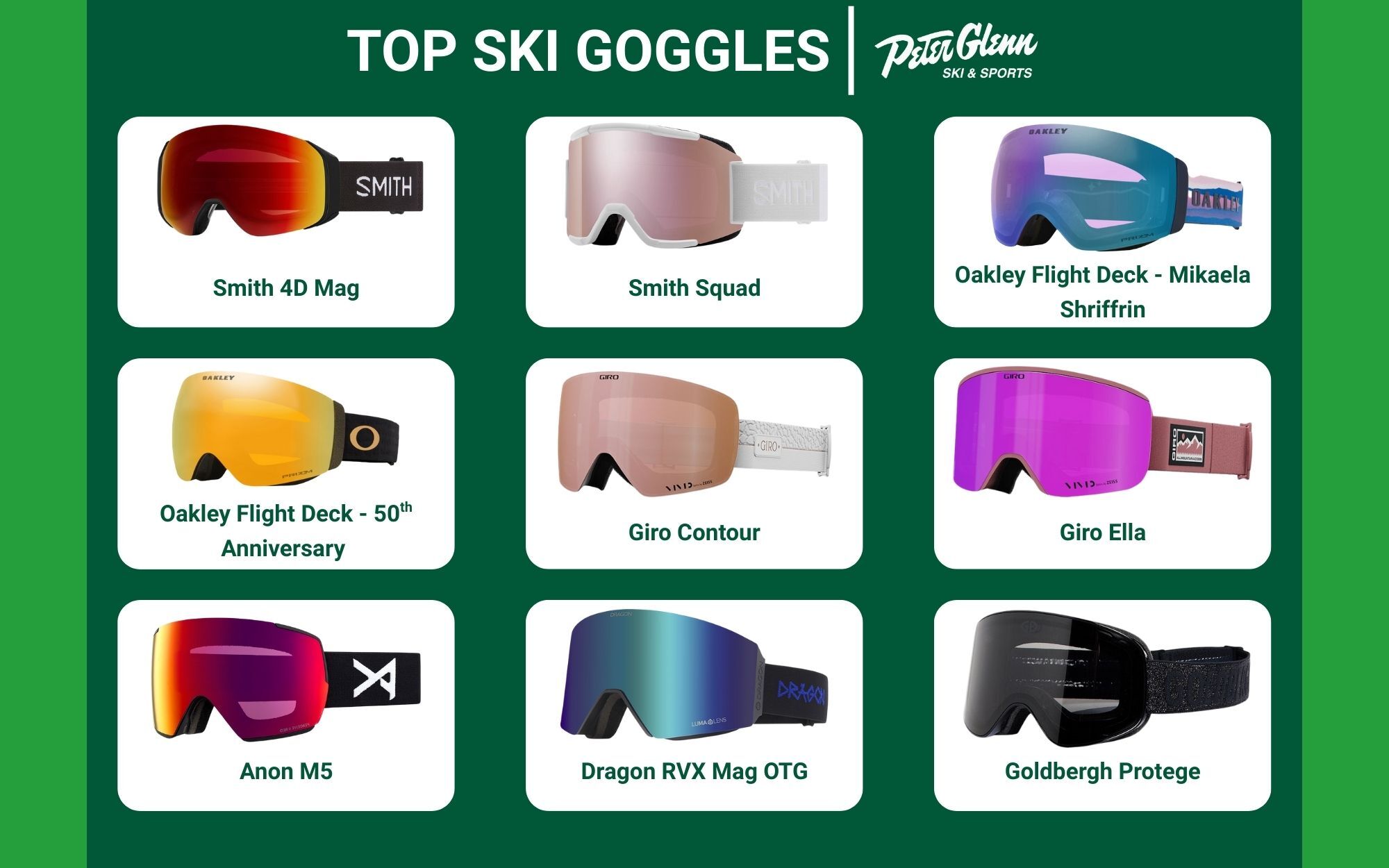
Here are some standout models worth considering:
- Smith 4D Mag: A spherical lens with Smith's BirdsEye Vision technology for expanded downward peripheral vision
- Smith Squad: A solid mid-range option with ChromaPop lenses and easy lens swaps
- Oakley Flight Deck Pro: Rimless spherical design with a wide field of view, available in special editions including the Mikaela Shiffrin signature and 50th Anniversary models
- Giro Contour: Quick-change magnetic lens system with VIVID lens technology
- Giro Ella: Designed for a women's fit with the same VIVID optics
- Anon M5: Magnetic Facemask Integration and Perceive lens technology for excellent clarity
- Dragon RVX Mag OTG: Frameless design with OTG compatibility and quick magnetic lens changes
- Goldbergh Protege: Style-forward option that combines fashion with function
Find Your Perfect Pair at Peter Glenn
The best ski goggles for you depend on your face shape, the light conditions you typically ride in, and whether you need features like OTG compatibility or quick-change lenses. Focus on finding a comfortable fit with your helmet, choose a lens option that matches your usual weather conditions, and make sure you have adequate UV protection.
Peter Glenn carries a full selection of ski goggles from brands like Smith, Oakley, Giro, Anon, and Dragon. With over 65 years of ski expertise, our team can help you find the right pair for your riding style. Browse our collection online or visit one of our locations to try on different frames and see how various lens tints look in person.